
Alternator vs Battery: How to Tell Which One Failed
7 September 2026 · 6 min read
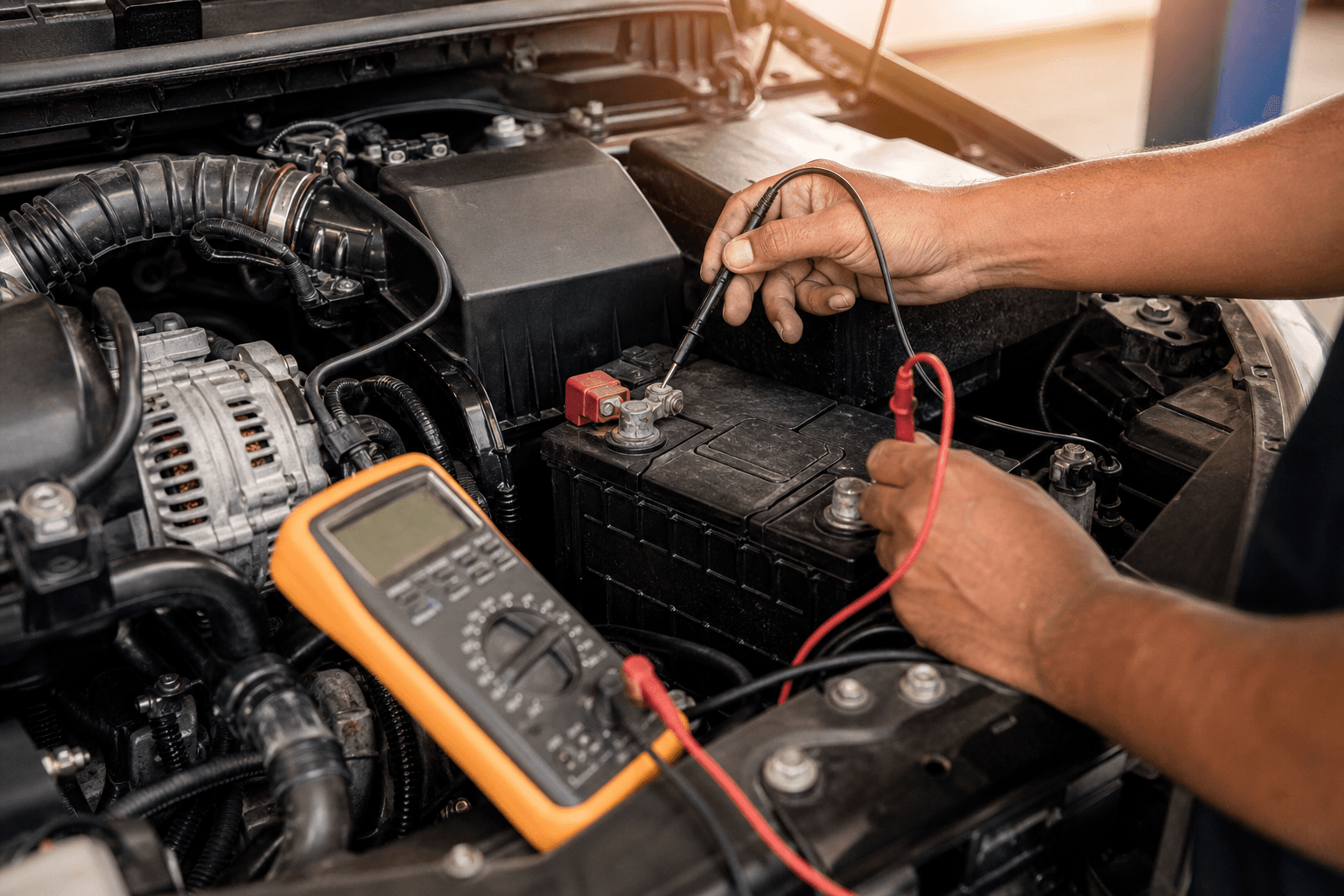
Your car won’t start — or it starts, then dies a few kilometers later. Friends say “change the battery.” Sometimes they’re right. Sometimes the battery is fine and the alternator (the charging unit driven by the belt) isn’t replenishing it. In Erbil’s heat, both fail more often, and guessing can mean paying twice: a new battery that dies again in days because the charging system is bad.
What each part does
- Battery: stores electricity to crank the engine and power electronics when the engine is off or at idle with heavy load.
- Alternator: generates power while the engine runs — recharges the battery and runs lights, AC blower, and other loads.
- If the battery is weak: hard or no start, especially after sitting in the sun.
- If the alternator is weak: the car may start (on leftover battery charge), then stall, or the battery light comes on while driving.
Signs it is usually the battery
- Slow or labored crank, then no start — especially first start of the morning or after the car sat hot all day
- Clicking relay sound with no crank
- Jump-start works, and the car keeps running fine afterward (for a while)
- Dim interior lights before you turn the key; radio or clocks reset
- Battery is 3–5+ years old, swollen, cracked, or leaking
- You needed more than one jump in a short period with mostly short city trips
Signs it is usually the alternator
- Battery / charging warning light on while the engine is running
- Car starts with a jump, then dies once you disconnect the cables — or dies after 10–30 minutes of driving
- Headlights or dash lights dim at idle and brighten when you rev (or the opposite, flickering)
- Burning smell, whining/grinding from the belt area, or a loose/squealing serpentine belt
- New battery still goes flat within days
- Multiple electrical weirdness while driving: warning lights, weak AC blower, stalling
Simple checks (not a full diagnosis)
These are clues, not a substitute for a load test and charging-system test:
- Resting battery voltage (engine off, after sitting): around 12.4–12.7 V is typical for a healthy charged battery; much lower suggests a drained or failed battery
- Running voltage (engine on): often about 13.5–14.7 V if the alternator is charging — if it stays near 12 V or below while running, suspect charging problems
- Corroded or loose battery terminals can mimic both failures — clean, tight connections first
- Don’t keep jump-starting for weeks without testing — you can damage a weak alternator or leave yourself stranded on the highway out of Erbil
Why heat in Erbil confuses the picture
Summer heat ages batteries faster and stresses charging systems (AC load, cooling fans, idle in traffic). A battery that barely passes in spring can fail in August — and an alternator that overheats or has a failing regulator can look like “another dead battery.” That’s why we test both before recommending a replacement.
What we do at Nashwan
At Nashwan Cars Service Center in Erbil (108 Industrial Street, Ankawa) we load-test the battery, check charging voltage and related connections, and tell you clearly whether you need a battery, an alternator-related repair, or both — with transparent pricing before any work. Most battery replacements are same-day; charging-system work depends on the diagnosis.
Don’t guess — test once
If your car is hard to start, the battery light is on, or you’ve already jump-started more than once, bring it in before the next no-start. One proper test is cheaper than the wrong part and a tow.
Need service in Erbil?
Visit Nashwan Cars Service Center for quality products, honest diagnostics, and clear recommendations for your vehicle.